

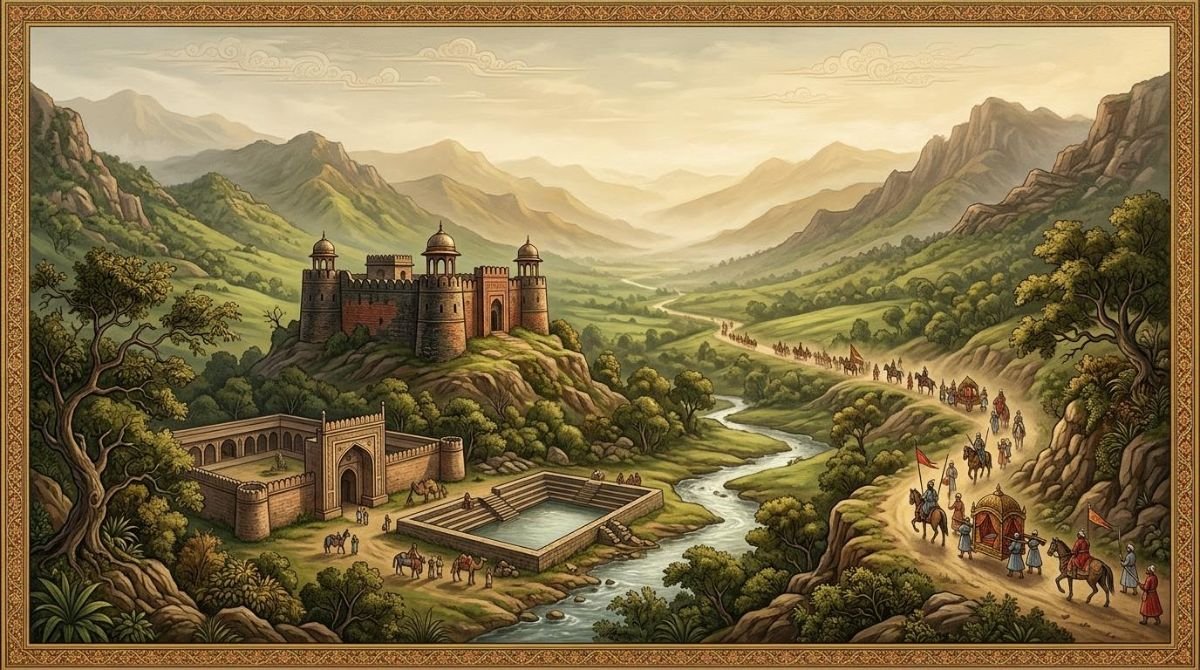
The Samahni Chibs (خاندانِ سماہنی) are a branch of the Chib Rajputs settled in the Samahni valley of Bhimber District, Azad Jammu and Kashmir, descended from Raja Shah Khan, a great-grandson of Baba Shadi Shaheed. Samahni history, as the Chib chronicles tell it, centres on Raja Hakim Khan, a courtier of the Mughal emperor Aurangzeb who founded the Kot (fort) of Samahni and whose granddaughter, the book says, was the mother of the future emperor Bahadur Shah I.
At a glance
- Where
- Samahni valley, Bhimber District, Azad Jammu and Kashmir
- Descent
- Baba Shadi Shaheed › Raja Mal Khan › Raja Ali Ghiyas (Alghas) Khan › Raja Shah Khan
- Got
- Samahnial (Samahniyal), of the Thotha Rai Bahadur house
- Famous ancestor
- Raja Hakim Khan, at the court of Aurangzeb
- Seat
- The Kot (fort) of Samahni
- Jagir villages
- Dab, Sandu’ah, Ramloh (Ralwah) and Sarsala
- Later jagirdar
- Raja Mahmud Khan, builder of the shrine tank (1886)
- 20th century
- Raja Buddhe Khan, Zaildar of Samahni
Samahni history: the valley and its monuments
The Samahni valley lies north of Bhimber, beyond the hill of Aadhi Dhak where Baba Shadi Shaheed’s shrine stands, on the line of the old Mughal road to Kashmir. The book describes it as a green and lovely valley, and it was dear to the early Chib rajas. Raja Goja Chand is said to have made his capital at Chowki Bandi, three miles west of Samahni, where his samadh (memorial), venerated as Goja Pir, still stands beside the Samahni–Mirpur road; he and his son Raja Shadab Khan, escaping the heat of Bhimber, also kept a summer residence in the valley, called in the old texts Bhaddu Dhara (reading uncertain). At Ralwah, near Samahni, is Thal Pir, where tradition says Raja Shadab Khan’s brother Raja Dal Khan was killed.
Older remains are scattered through the valley. Between Samahni and Bandala stand two ancient temples of huge black stones, which local people call the Dhere and ascribe to giants and fairies; nearby are traces of a pond known as Pariyon ka Talla, “the Fairies’ Pond”, and farmers have ploughed up bronze vessels and old coins. The Mughals left the Sarai of Sa’dabad beside Bandala, which the book says is named after Sa’d Khan, Shah Jahan’s superintendent of buildings, and on the hill above it the fort of Baghsar.
Today Samahni is a sub-division of Bhimber District; the book credits that status to the efforts of Raja Maqsood Ahmad Khan of Bandala, elected to the Azad Kashmir Assembly from Samahni in 1985.
From Raja Mal Khan to Raja Shah Khan
The Samahni family, one of the branches of the Chib Rajputs, belongs to the house of Raja Mal Khan, the son of Baba Shadi Shaheed who received Khari Kariali, the western half of the old Chib state of Bhimber, while his elder brother Raja Bhom Khan kept the throne (see The Rajas of Bhimber). Mal Khan’s line is known as Chibhal Rekah, or Raika. His eldest son, Raja Ali Ghiyas Khan — remembered by the bards as Raja Alghas or Algas Khan, and described as an influential member of the Mughal court — had three sons: Raja Buddha Khan, Raja Shah Khan and Raja Jabbu Khan.
Buddha Khan’s descendants founded Thotha Rai Bahadur and a great many other villages, and Jabbu Khan’s settled at Bisa Kalan, Bisa Khurd, Jagoan and Kotla. The Samahni family descends from the middle son, Shah Khan, who stayed on at Balani, the family seat on the old imperial road. The tables of old landholdings at the end of the book list the Samahnial got among the branches of the Thotha Rai Bahadur house.
- Raja Shadab Khan (Baba Shadi Shaheed)
- Raja Mal Khan — Khari Kariali (Chibhal Rekah)
- Raja Ali Ghiyas (Alghas) Khan
- Raja Buddha Khan — Thotha Rai Bahadur and its branches
- Raja Shah Khan — ancestor of the Samahni family
- … Raja Hakim Khan — founder of the Kot of Samahni
- … Raja Mahmud Khan, son of Rafiullah — jagirdar in the 1880s
- … Raja Buddhe Khan — Zaildar of Samahni in the twentieth century
- Raja Jabbu Khan — Bisa Kalan, Bisa Khurd, Jagoan and Kotla
- Raja Ali Ghiyas (Alghas) Khan
- Raja Mal Khan — Khari Kariali (Chibhal Rekah)
In the oldest history (c. 1926)
The family tree in Thakur Major Singh’s Tarikh-e-Chibhal (c. 1926), the oldest written history of the Chibs, suggests a different descent. It gives Raja Dharam Chand, the name the book uses for Raja Shadab Khan, four sons rather than three: Raja Bhup or Bhum Chand, Raja Rup or Udap Chand, Raja Mal and, fourth, Raja Gul Mural (reading uncertain), beside whose name is written “Khandan Samahni”, the Samahni family (Major Singh (c. 1926), p. 19). Both the name and the caption are faint in the old lithograph, so neither reading is certain.
If they are right, the 1926 tree makes the Samahni family a separate line descending from Baba Shadi Shaheed, not a branch of Raja Mal Khan’s house as the 1997 history and Maulvi Zain-ul-Abidin’s manuscript have it. No such son appears in the 1997 history’s lists of the saint’s sons, and the same 1926 book, in a later page quoted in the 1997 history, traces the family to Chhani Gotriala and Hakim Khan without naming its ancestor (Iftikhar Ali Khan (1997), p. 331). The question will stay open until the rest of the 1926 book is found. The whole 1926 tree is given in The Chib Shajra: 481 Generations in Tarikh-e-Chibhal.
Raja Hakim Khan, courtier of Aurangzeb
Among Shah Khan’s descendants the most famous was Raja Hakim Khan. The book preserves two versions of his story.
The Samahni historian’s account
Maulvi Zain-ul-Abidin Kohi Samahnavi, Samahni’s own historian, wrote in his manuscript that Hakim Khan’s daughter’s daughter Raj Bai — daughter of Chatar Sainha (reading uncertain), the Jarral Raja of Rajaur (Rajouri) — was the favourite consort of the emperor Aurangzeb Alamgir and the mother of Muazzam Shah, later ruler of the empire. Through this connection Hakim Khan had great access at the Mughal court. He left Gotriala for the Samahni tract, then called Bhaddu Dehra Thath (reading uncertain), where he received many villages in jagir with a mansab (rank) of twelve thousand — an exceptionally high rank by Mughal standards — and laid the foundations of the Kot, the fort of Samahni. At one time the family was also given a mandi of its own, which was later abandoned.
Thakur Major Singh’s account
Thakur Major Singh’s Tarikh-e-Chibhal (1926) is more modest. It says the family formerly lived at Chhani Gotriala, in British territory, and that Hakim Khan was the emperor’s chauri-bardar, the bearer of the royal fly-whisk. From Gotriala the family’s elder came to the Samahni area, where the state granted it a jagir.
In the oldest history (c. 1926)
The rest of Thakur Major Singh’s Tarikh-e-Chibhal (c. 1926), now read in full, settles the name left uncertain on its family tree. The fourth son of Raja Dharam Chand is Gul Muhammad Khan, who, like his brother Mal Khan, became a Muslim, took his share of land from Mal Khan and settled at a place whose name is unclear in the print; a later chart marks his line “the Samahni family” (Major Singh (c. 1926), pp. 35, 42). Yet when the author reaches Samahni itself he is careful. Full enquiries, he writes, have not yet been made: the family is said to descend from Gul Muhammad Khan, but the accounts of the Hindu Bhats and Mirasis, the hereditary bards and genealogists, mention only three sons of Raja Dharam Chand (p. 92). He then gives the account summarised above, of Chhani Gotriala, Hakim Khan the chauri-bardar and the jagir, and ends with Raja Mahmud Khan’s tank at the shrine.
Elsewhere the book counts Samahni among the four chief dheris of Khari Kariali, whose sardars each held four villages (p. 89), and its table of the great Chib jagirs values the Samahni jagir at 4,000 a year, with the title Raja (p. 102). For the four brothers and how the line divided, see How the Chibs divided into Hindu and Muslim lines.
Raj Bai or Nawab Bai?
Mughal histories know the Rajouri princess who bore Aurangzeb’s son Prince Muhammad Muazzam — the emperor Bahadur Shah I, who reigned from 1707 to 1712 — as Nawab Bai. The book itself uses both names: Raj Bai in the Maulvi’s account, and Nawab Bai, daughter of a Raja Sainha of Rajouri, in the Thakur’s. The link between the Rajouri princess and Samahni rests on Chib family tradition.
A blood feud with Thotha Rai Bahadur
The Thakur also tells how Hakim Khan’s ambition ended. Coveting the eighty-four villages held by his kinsman Rai Shujawal Khan, chief of Thotha Rai Bahadur, Hakim Khan bribed a Mirasi, one of the hereditary bards and genealogists, to kill him. The assassin struck at Shujawal Khan as he slept, and the sword cut off the chief’s feet. Hakim Khan withdrew to Delhi. When he next came home, Shujawal’s son Rai Baz Khan seized his chance and beheaded him.
Because Hakim Khan was an officer of the imperial court, the emperor confiscated the eighty-four villages and held Rai Baz Khan in confinement for a time; he came home with a grant for only twenty-two. Another passage in the book confirms that in Rai Baz Khan’s time all but twenty-two villages were confiscated “in connection with the killing of Hakim Khan Samahniyal”.
The Kot and the Samahni jagir
Maulvi Zain-ul-Abidin lists the villages that went with the Samahni share, or dheri: Dab, Sandu’ah, Ramloh and Sarsala, along with the old site of the abandoned mandi. The tables of old landholdings at the end of the book name Hakim Khan as chief of the Samahni dheri — one of the four senior dheris of Chibhal Raika, whose chiefs each held a small group of villages — with Samahni, Dab, Sandu’ah, Kot and Ralwah; a note adds that Ralwah was a jagir held together with Kot Samahni. Chak Sarsala, near Samahni, once part of the Thotha Rai Bahadur holding, had disappeared by the time the book was written.
Raja Mahmud Khan and the tank at the shrine
In the 1880s the jagirdar of Samahni, Raja Mahmud Khan, built a masonry tank beside the shrine of Baba Shadi Shaheed on Aadhi Dhak, fed by a stone channel that collects rainwater from the hillside. Its Persian inscription names the builder as Mahmud Khan son of Rafiullah, of Jagir Sahan (reading uncertain), and records that it was completed in the month of Shawwal 1303 AH — July 1886. The tank was rebuilt in December 1986, and the shrine’s old domed mosque stands beside it.
Not far away is another gift from Samahni: the Sukka Talab, the “Dry Tank”, on the old road below Aadhi Dhak, built in Chait 1937 Bikrami (about 1880) by a charitable Hindu merchant of Samahni whose name has been forgotten.
Sources differ
Hakim Khan appears as a high Mughal mansabdar in the Maulvi’s manuscript but as the emperor’s fly-whisk bearer in the Thakur’s history. The princess is Raj Bai, daughter of Chatar Sainha Jarral, in one account and Nawab Bai, daughter of Raja Sainha, in the other, and the family’s earlier home is printed both as Gotriala and as Goriala. For the shrine tank, the Persian inscription gives Shawwal 1303 AH (1886), while the Thakur, as quoted, gives 1942 Bikrami (c. 1885) in one passage and 1940 Bikrami (c. 1883) in another.
Samahni in the twentieth century
The best-known Samahni Chib of modern times is Raja Muhammad Zaman Ali Khan, known as Raja Buddhe Khan, Zaildar and Jagirdar of Samahni, who led the valley in the 1931 movement against Dogra rule and again in the fighting of October 1947. The book also profiles:
- Raja Fateh Khan, Buddhe Khan’s younger brother, a popular figure across the valley’s biradaris who brought development projects to Samahni, took part in the events of 1947 and was President of the Tehsil Muslim Conference, Bhimber;
- Raja Zulfiqar Ali Khan, Buddhe Khan’s son, a social and political worker and former chairman of Union Council Chowki;
- Major Raja Fateh Khan, of another Samahni family, who retired from the army as a major;
- Professor Raja Manzoor Ahmad Khan, an educationist long settled in England;
- Raja Abdul Rahman Khan, who passed his matriculation at Bhimber in 1955, became headmaster of the Government Pilot High School at Samahni and later a District Education Officer;
- Raja Rahmatullah Khan and Raja Latif Khan, social and political workers and members of the advisory committee of Baba Shadi Shaheed’s shrine.
The book ends the chapter with the leading men of other villages of the valley:
| Village | Leading figures named in the book |
|---|---|
| Dab and Sandu’ah | Haji Raja Khizar Hayat Khan, a Muslim Conference leader and former president of the party in the Samahni constituency; Numberdar Raja Allah Ditta Khan; Raja Abbas Khan, Advocate |
| Pindori | Professor Raja Muhammad Asghar Khan, Principal of Crescent Public School, Rawalpindi; Subedar Raja Muhammad Yousaf Khan |
| Tonin (reading uncertain) | Raja Taj Muhammad Khan, Numberdar; Jamadar Ata Muhammad Khan; Raja Muhammad Iqbal Khan, headmaster |
| Bandi | Raja Syed Muhammad Khan, Numberdar; his son Raja Muhammad Yaqub Khan, retired Naib Tehsildar; Raja Muhammad Afzal Khan, District Councillor |
| Chowki | The numberdars of the Ghanial wand, from Raja Hashim Khan through Jamadar Raja Rahim Bakhsh Khan and Raja Syed Muhammad Khan to Raja Farzand Ali Khan and Raja Birbal Khan (reading uncertain); Raja Ghazanfar Ali Khan and Raja Muhammad Azam Khan, advocates at Samahni; Raja Muhammad Ayub Khan, bank officer |
Much of what is known about the family comes from Samahni itself. Maulvi Zain-ul-Abidin “Kohi” of Chowki Samahni compiled the unpublished manuscript history that the book quotes so often, and his heirs at Samahni kept one of the genealogies the author consulted (see The Historians of Chibhal). The valley’s other Chib families are described in Mandi Bandala and Mandi Ghawaliyan.
Frequently asked questions
Who are the Samahni Chibs?
They are a branch of the Chib Rajputs of the Samahni valley in Bhimber District, Azad Kashmir, descended from Raja Shah Khan, son of Raja Ali Ghiyas Khan and great-grandson of Baba Shadi Shaheed. Their best-known ancestor is Raja Hakim Khan, founder of the Kot of Samahni, and their best-known modern figure is Raja Buddhe Khan, Zaildar of Samahni.
Who was Raja Hakim Khan of Samahni?
According to the Chib histories quoted in the 1997 book, Raja Hakim Khan was a Chib noble at the court of Aurangzeb who moved from Gotriala to the Samahni tract, received a large jagir and founded the Kot (fort) of Samahni. One account makes him a high-ranking mansabdar, another the emperor’s fly-whisk bearer; he was later killed by Rai Baz Khan of Thotha Rai Bahadur in a blood feud.
Was Hakim Khan’s granddaughter the mother of a Mughal emperor?
The book says so: his daughter’s daughter, a princess of the Jarral house of Rajouri whom it calls Raj Bai (and in one passage Nawab Bai), was Aurangzeb’s favourite consort and mother of Muazzam Shah. Mughal histories name the mother of Prince Muazzam, the future Bahadur Shah I, as Nawab Bai of Rajouri; the Samahni connection rests on Chib family tradition.
Where is the Samahni valley?
The Samahni valley lies north of Bhimber town in Bhimber District, Azad Jammu and Kashmir, beyond the hill of Aadhi Dhak and on the line of the old Mughal road to Kashmir. It is now a sub-division of the district; its villages include Samahni, Chowki, Bandi, Bandala, Dab, Sandu’ah and Ralwah.
Which villages formed the Samahni jagir?
Maulvi Zain-ul-Abidin’s manuscript lists Dab, Sandu’ah, Ramloh (Ralwah) and Sarsala with the Kot of Samahni, while the book’s tables of old landholdings give Samahni, Dab, Sandu’ah, Kot and Ralwah as the share held by Hakim Khan.
Sources
- Thakur Major Singh Chib, Tarikh-e-Rajgan-e-Bhimber wa Qaum-e-Chibhal (Tarikh-e-Chibhal; Urdu, c. 1926), pp. 19, 26, 35, 42, 89, 92, 102.
- Raja Muhammad Iftikhar Ali Khan, Raja Shadab Khan alias Hazrat Baba Shadi Shaheed (Urdu, Barhang/Karachi, 1997), pp. 38–40, 68–69, 83–85, 92–93, 97, 111–112, 117–118, 140–144, 279–280, 331–335, 401–406.
- Maulvi Zain-ul-Abidin Kohi Samahnavi, unpublished manuscript history of Chibhal (section “Raja Shah Khan, second son of Raja Alghas Khan”), as quoted in the book.
- Thakur Major Singh of Dewa Vatala, Tarikh-e-Chibhal (Urdu, printed 1983 Bikrami ≈ 1926), pp. 85–87 and 92, as quoted in the book.
- Persian inscription of Raja Mahmud Khan’s tank at the shrine of Baba Shadi Shaheed (Shawwal 1303 AH), transcribed in the book, p. 85.
This article is part of our series based on the 1997 Chib history; see the book, chapter by chapter. Spellings of names follow the book.
Continue reading
Have a question about this history?
Our AI guide answers from the articles on this site, in English or Urdu.
