

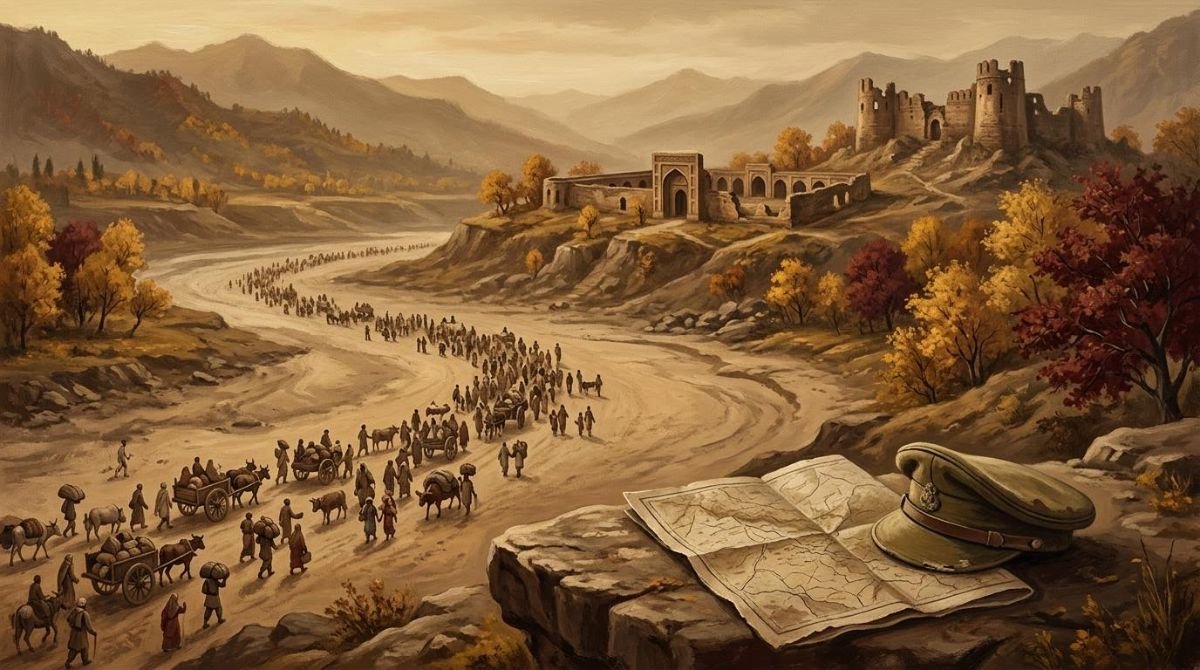
The Chib Rajputs (چب راجپوت; also written Chibh or Chhib) of Bhimber, Samahni, Kotli and Kharian lived through 1947 on the front line between the princely state of Jammu and Kashmir and the new Pakistan. According to Raja Muhammad Iftikhar Ali Khan’s 1997 history of the clan, Chib Rajputs in 1947 led the capture of Bhimber on 26 October, raised some of the first Azad Kashmir battalions, died in the killings around Jammu and led whole villages to safety as refugees. When the ceasefire line was drawn in 1949, it ran straight through their old homeland of Chibhal.
At a glance
- Where
- Chibhal: Bhimber, Samahni and the Banah valley (Kotli) in today’s Azad Kashmir, and Kharian in Pakistan’s Gujrat district
- Decisive date
- 26 October 1947, the capture of Bhimber
- Commander
- Brigadier Raja Habib-ur-Rahman Khan of Panjeri, Fateh-e-Bhimber (“Conqueror of Bhimber”)
- Units raised
- Darhal Battalion (later AK 16); Banah Battalion (later 25 Haidri Battalion)
- Losses recorded
- About 15 Barhang volunteers at Bhimber; S.I. Raja Suhbat Ali Khan in Jammu; Raja Muhammad Sarwar Khan at Udhampur; soldiers on the Skardu and other fronts
- Refugees
- Pothi Jang Khan and its fourteen hamlets moved to Balani and Bisa near Kharian
- Ceasefire
- 1 January 1949; Naushera, Rajal and the Khori jagir left on the Indian-administered side
Chib Rajputs in 1947: a clan on the coming frontier
By 1947 the Chibs had not ruled Bhimber for more than a century. Their state of Chibhal, the hill country between the Jhelum and the Chenab whose capital was known as the “Gate of Kashmir”, had been absorbed by the Dogra rulers of Jammu after the fall of Raja Sultan Khan (see the end of Chib rule), while its southern villages around Kharian had passed to the British district of Gujrat. In August 1947 those Punjab villages became part of Pakistan; Bhimber, Samahni and the Banah valley still belonged to Maharaja Hari Singh, who had not yet decided his state’s future.
Many Chib men were soldiers or ex-soldiers, and many held the Maharaja’s offices as jagirdars, zaildars, numbardars, policemen and revenue officials. The book returns again and again to the dilemma this created: men such as Khan Inayatullah Khan of Khui Ratta and Raja Datta Khan, numbardar of Pothi, were officials of a government whose army was about to fight their own people. Most of the Chib leaders it names had by then joined the Muslim Conference, founded in 1932.
The battle for Bhimber, 20–26 October 1947
The best-documented episode is told day by day in The Liberation of Bhimber, October 1947. On 20 October the Tehsildar of Bhimber, Sardari Lal Sharma, ordered the people of Barhang, Barsali, Dhandar, Kadhala and Barnala to leave for the northern hills. Instead the villagers sent their families across the border into Pakistan, and the men, many of them ex-servicemen, collected rifles and formed squads. Their first assault on 22 October, under Subedar Major Raja Abdullah Khan of Barhang, ran into machine guns at the rest house, the Jami Masjid and the tehsil building, and about fifteen volunteers from Barhang alone were killed.
On 23 October Brigadier Raja Habib-ur-Rahman Khan of Panjeri, a British Indian Army and Indian National Army officer who had come home that month, took command and organised three companies. Two small tanks from Pakistan, delayed when they stuck in sand near Rani ka Kunwan, shelled the defences on the night of 24/25 October, and the assault from three sides took the town on 26 October 1947, the date usually given for Maharaja Hari Singh’s signature of the Instrument of Accession to India. The book credits the early fall of Bhimber with saving the rest of Mirpur district, and names Raja Diwan Ali Khan of Pothi Jang Khan among the attackers.
Sources differ
The book tells the story twice: the local narrative (pp. 44–47) describes two days of fighting by village squads before the Brigadier took over, while the chapter devoted to him (pp. 297–298) presents a lightning attack by his small band. The narrative also prints “23 August 1947” for what the sequence shows to be 23 October.
From Samahni to Skardu: the other fronts
North of Bhimber, Raja Buddhe Khan, zaildar of Samahni and hero of the 1931 agitation, is credited with clearing the country from Beri Pattan to Khariala. In the same valley Raja Rahmdad Khan of Ghawaliyan fought beside Raja Muhammad Afzal Khan, zaildar of Bandala, and in Malot the head zaildar, Raja Allah Ditta Khan, led the fighters of his area against the State forces.
In the Banah valley of Kotli, a Dogra column looted Khui Ratta and burned the house of its chief jagirdar, Subedar Khan Inayatullah Khan, who in January 1948 raised the Banah Battalion, later 25 Haidri Battalion. The same chapter records that on the night Indian troops relieved the besieged garrison at Kotli, Mirpur city was taken by fighters under Colonel “Khan of Mang” and Captain Raja Muhammad Afzal Khan of Kalri. To the east, Major Raja Muzaffar Khan, once ADC to Maharaja Hari Singh, raised the Darhal Battalion, later AK 16, and fought on the Rajouri and Darhal Malkan fronts. Behind the lines, Ghazi Raja Shafa’at Khan of Pothi Jang Khan ran camel trains of arms from the Bhimber depot to Jandi Chontra and Sarai Saadabad; the book cites Pakistan Army GHQ records for his service.
Some never came home. Havildar Raja Sahibdad Khan of Ghawaliyan, of No. 6 Jammu and Kashmir Regiment, was killed on the Skardu front, and Major Raja Muhammad Afzal Khan of Kalri, honoured as Fakhr-e-Kashmir (“Pride of Kashmir”), was killed in 1948; the town of Afzalpur, formerly Gobindpur, is named after him. The book does not say whether he is the captain of the same name who helped take Mirpur.
Killings in Jammu and Udhampur
Chibs serving the State far from home were caught in the violence that swept the Jammu region that autumn. Raja Suhbat Ali Khan of Ghawaliyan, born in 1913, was the police sub-inspector in charge of Thana Gumat in Jammu city. Sent out with a single constable to investigate a disturbance in which fleeing Muslims were being killed, he was shot dead near the Tawi in October 1947; a Pothi Jang Khan policeman, Raja Hakim Khan, witnessed the killing and escaped across the river. The book places the general massacre of Jammu’s Muslims after his death: two young relatives living with him were in a refugee convoy that was attacked, and his son was badly wounded. That same month the eldest son of Panjeri’s Sardar Rahim Dad Khan, Raja Muhammad Sarwar Khan, a Wazir-e-Wazarat (district officer) in the Dogra service, was killed at Udhampur.
Refugees and a divided land
Whole villages moved. Raja Datta Khan, numbardar of Pothi Jang Khan, set aside the Dogra government’s orders and led the Muslims of Pothi and its fourteen hamlets (mohras) first to Sokra and Char on the Kharian border and then to Balani and Bisa, where he devoted himself to their resettlement (see Pothi Jang Khan and Chahi). In the Punjab, Major Muhammad Aslam, a son of Raja Muhammad Khan Chib of a village near Sarai Alamgir, is credited with bringing thousands of Muslim families safely to Pakistan in August 1947.
When the ceasefire took effect on 1 January 1949, the line ran through the heart of old Chibhal. Naushera, Khamba, Rajal, the Khori jagir of Mandi Bandala and Jogi Hattiyan near Sarai Saadabad were left on the Indian-administered side, which the book calls “Occupied Kashmir”, and families from Rajal rebuilt their lives at Lala Musa, Khair Ghansar and elsewhere in Pakistan. As Director for Refugees for Jammu and Kashmir until June 1954, Brigadier Habib-ur-Rahman oversaw the settlement of refugees in Sialkot, Gujrat and Jhelum.
The book is written from the side of the Muslim Chibs, but its pages show that 1947 uprooted others too. The Hindu and Sikh residents of Khui Ratta fortified their houses and then left, and when Raja Sakhi Daler Khan, commanding on the Kotli front, cleared Inayatullah Khan of charges brought by rivals, he praised the jagirdar for harming none of them, since any killing would have brought reprisals on unarmed Muslims:
By your prudence and wisdom you saved the whole Banah valley from ruin.
— Raja Sakhi Daler Khan to Khan Inayatullah Khan, as quoted in the book, p. 232
Across the new line, the Hindu Chibs of Dewa Vatala, descendants of Raja Ghaggi Khan and the family of the first Chib historian, Thakur Major Singh, lost their homeland: Partition, the book says, closed the chapter of Vatala’s history and the war of 1971 finished what remained. In the last months of 1947 Muslim, Hindu and Sikh families alike were killed or driven from their homes across Jammu, Mirpur and Rajouri; the book’s lists of the dead, such as “Bota, martyred 1947” in the family tree of Malot, record only one part of that loss.
Building Azad Kashmir
Those who stayed built a government from nothing. Raja Imdad Ali Khan of Ghawaliyan, probably the first graduate of Chibhal Rajana, became the first Sub-Judge of Bhimber early in 1948, holding court at Gotriala in Tehsil Kharian; Raja Rangbaz Khan, Raja Rahmdad Khan’s son, was among the first officials of the Azad Jammu and Kashmir government; and Brigadier Habib-ur-Rahman, Chief of Staff of the Azad forces from January 1948, represented them before the United Nations Commission for India and Pakistan. The soldiers and politicians who followed are traced in our articles on Chib soldiers and Chib Rajputs in Kashmir politics, and the wider story of the clan in Chib Rajputs: history, origins and clans.
Timeline: the Chibs in 1947–49
- August 1947 Partition. The Chib villages of Kharian fall in Pakistan; Major Muhammad Aslam escorts thousands of Muslim families to safety.
- October 1947 Raja Suhbat Ali Khan is killed in Jammu and Raja Muhammad Sarwar Khan at Udhampur; the people of Pothi Jang Khan cross into Pakistan.
- 20–25 October 1947 Evacuation order at Bhimber; the first assault fails; Habib-ur-Rahman takes command and the tank-supported attack begins.
- 26 October 1947 Bhimber is captured.
- Late 1947 Indian troops relieve Kotli; the same night, by the book’s account, Mirpur city is taken.
- January 1948 The Banah Battalion is raised; Habib-ur-Rahman becomes Chief of Staff; Raja Imdad Ali Khan becomes Sub-Judge of Bhimber.
- 1 January 1949 The ceasefire comes into force and the line divides Chibhal.
Frequently asked questions
What did the Chib Rajputs do in 1947?
According to Raja Muhammad Iftikhar Ali Khan’s 1997 history, Chib Rajputs of Bhimber, Samahni and the Banah valley took up arms against the Dogra State forces in October 1947, led the capture of Bhimber on 26 October and raised units such as the Darhal and Banah battalions. Others were killed in the violence around Jammu or led their villages to Pakistan as refugees.
Who captured Bhimber in October 1947?
Bhimber was taken on 26 October 1947 by local volunteers, many of them ex-servicemen from Barhang, Dhandar and nearby villages, under the command of Brigadier Raja Habib-ur-Rahman Khan of Panjeri, remembered as Fateh-e-Bhimber, the Conqueror of Bhimber. Two small tanks from Pakistan supported the final assault.
Who was Raja Suhbat Ali Khan Shaheed?
Raja Suhbat Ali Khan (born 1913) of Ghawaliyan near Samahni was the police sub-inspector in charge of Thana Gumat in Jammu city. In October 1947 he was shot dead near the Tawi while investigating attacks on fleeing Muslims, and the book honours him as the Martyr of Jammu.
Did Hindu Chibs also lose their homes in 1947?
Yes. The Hindu Chibs of Dewa Vatala, descendants of Raja Ghaggi Khan, lived in the foothills east of Bhimber. The book says Partition ended their centuries-long history there and the war of 1971 completed it, forcing them to leave their ancestral land.
Sources
- Raja Muhammad Iftikhar Ali Khan, Raja Shadab Khan alias Hazrat Baba Shadi Shaheed (Urdu, Barhang/Karachi, 1997), pp. 40, 44–47, 73–78, 138, 228–237, 256, 259, 266–275, 276–288, 292–300, 309–311, 333, 410, 422, 447.
- Pakistan Army GHQ records, Rawalpindi, cited by the book for Raja Shafa’at Khan’s service in 1947 (p. 75).
This article is part of our series based on the 1997 Chib history; see the book, chapter by chapter. Spellings of names follow the book.
Continue reading
Have a question about this history?
Our AI guide answers from the articles on this site, in English or Urdu.
