

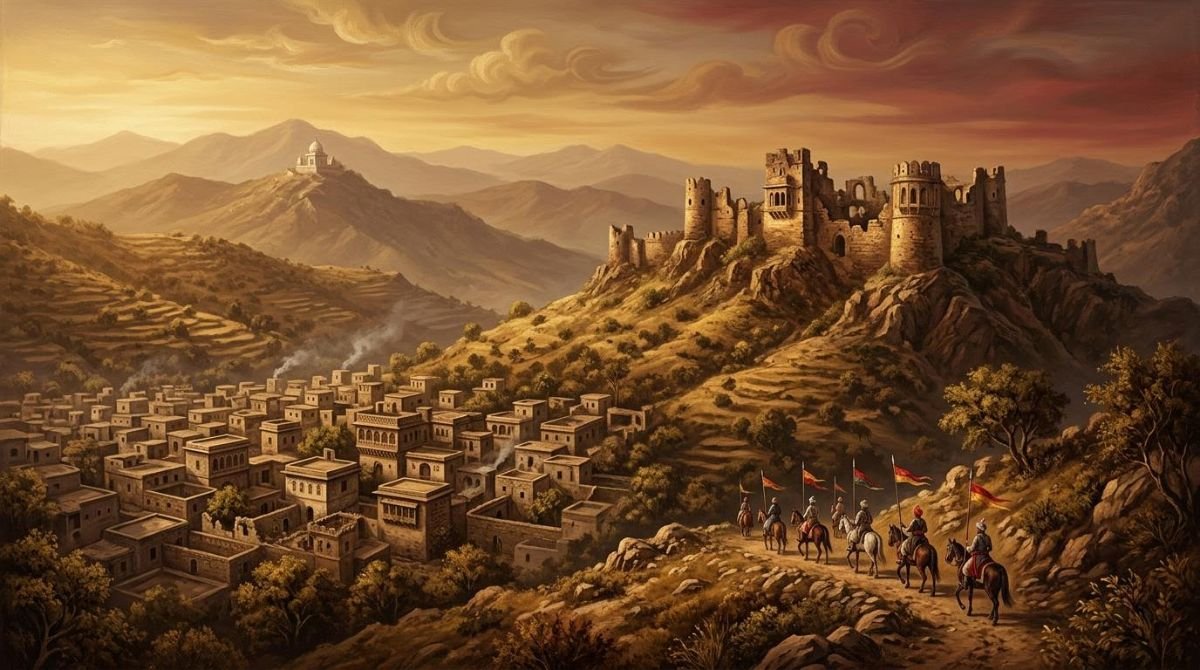
The Chib Rajputs (also written Chibh or Chhib; Urdu چب راجپوت) are a Rajput clan of the hill country between the Jhelum and Chenab rivers whose chiefs ruled the state of Bhimber, in today’s Azad Jammu and Kashmir, for some four centuries until the Sikh and Dogra conquests of the early 1800s. They trace their descent from the Katoch royal house of Kangra through Raja Chib Chand, and most Chibs are Muslims who honour as their ancestor Raja Shadab Khan, Baba Shadi Shaheed, whose shrine crowns a ridge above Bhimber.
At a glance
- Also written
- Chib, Chibh, Chhib; the clan also calls itself Chib Katoch
- Homeland
- Chibhal: Bhimber, Samahni, Mirpur and Kotli in Azad Kashmir; Kharian, Gujrat and Jhelum in Pakistan’s Punjab
- Descent
- The Katoch rajas of Kangra (Nagarkot), through Raja Chib Chand
- Founding
- Chib Chand won Bhimber by marrying the daughter of its raja, Sri Pat; the 1997 book dates this to the first quarter of the 15th century
- Great ancestor
- Raja Shadab Khan, Hazrat Baba Shadi Shaheed (16th century); shrine at Aadhi Dhak, north of Bhimber
- Two states
- Bhimber (Chibhal Rajana) and Khari Kariali (Chibhal Raika)
- Last ruler
- Raja Sultan Khan; the state of Bhimber ended in 1883 Bikrami (c. 1826)
- Faith
- Mostly Muslim; the Hindu Chibs of Dewa Vatala kept the old religion
Who are the Chib Rajputs?
The Chibs are one of the best-documented Rajput clans of the Bhimber–Mirpur region. Their homeland, Chibhal, is the belt of foothills that climbs from the plains of Gujrat and Jhelum towards the Pir Panjal range: today Bhimber, Mirpur and Kotli in Azad Kashmir, Tehsil Kharian in Pakistan’s Punjab and, across the Line of Control, the country around Naushera. Their capital, Bhimber, stood where the imperial road to Kashmir left the plains. Most Chibs are Muslims, descended from a raja who embraced Islam in the sixteenth century; the Chibs of Dewa Vatala remained Hindu. This guide follows the most detailed history of the clan, a 450-page Urdu work compiled in 1997 by Raja Muhammad Iftikhar Ali Khan of Barhang, and links to our articles on each part of the story.
From Kangra to Bhimber: the origin of the Chibs
The Chibs trace their descent to the Katoch rajas of Kangra, the old Nagarkot, whose genealogies reach back to the Mahabharata kingdom of Trigarta and whose stronghold was Kangra Fort. The account the 1997 book accepts comes from Tarikh-e-Chibhal, the clan’s chronicle. Raja Megh Chand, who ruled Kangra when Timur invaded India in 1398, had four sons. When the eldest, Hari Chand, vanished, the court passed over the next in age, Partab Chand, and crowned Karam Chand, a story continued in Guler and Kangra. Partab Chand soon died, and early in the fifteenth century his son Narain (or Nahar) Chand left Kangra for ever with his four sons, Chib, Dhru, Ambu and Aji Chand.
The exiles camped at Mughlora, east of Bhimber. A jewel they sold in the town reached its ruler, Raja Sri Pat of the Thakial Rajputs, who guessed their royal birth, married his only daughter to Raja Chib Chand and gave him villages east of the town. When Sri Pat died without a son, Chib Chand outmanoeuvred the Thakial heirs and took the throne, adopting their family priests, the Verha Brahmins, as his own.
Sources differ
A tradition recorded in the 1868 Gujrat Settlement made the Chibs descendants of an Iranian prince, which the 1997 book rejects as invented, and the dates given for Chib Chand range from about 1230 (Raja Wilayat Khan) to about 1400 (Griffin). Our article on the Katoch origins, following Hutchison and Vogel, makes Partab Chand himself the founder of Bhimber. The accounts are compared in Where Did the Chibs Come From?, and the wider background in Rajput History.
Chibhal, the land of the Chibs
The country was named after its rulers: Chibhal. The book traces its old boundary along the Gujrat–Jhelum railway, up the Jhelum past Khari Kariali, Kasgumah and Khui Ratta, south of the hills of Naushera and down the Tawi to Manawar. Under the last raja the state of Bhimber reached from Barnala in the east to Kharian and Gujrat in the south and took in Naushera, Mirpur and Kotli, and the rajas spent their summers at Amargarh fort above the lake of Baghsar. Bhimber guarded the road into Kashmir under the Sultans of Kashmir and the Mughals: Akbar renamed it Akbarabad and built the sarai whose rooms now house its courts (see Bhimber’s monuments, Gateway on the Mughal Road and Travellers in Chibhal). Older still are the ruins of Pani Koti near Bisa, remembered as the capital of King Porus, and the land’s ancient names are traced in From Abhisara to Chibhal.
Raja Goja Chand and his four sons
Five rajas followed Chib Chand before the throne passed to Raja Goja Chand (also Gorpal or Gopal Chand), remembered as Goja Pir, who ruled from Chowki Bandi, west of Samahni, built stepwells and roads, and is commemorated by a samadh at Chowki. His four sons founded four lines.
- Raja Goja Chand — “Goja Pir”
- Shadip Chand, later Raja Shadab Khan — Baba Shadi Shaheed, the eldest, who inherited Bhimber
- Raja Dal Khan — given Beri Pattan; he fought his brother and was killed at Raluh near Samahni, the spot now called Thal Pir
- Raja Chhel Khan — ancestor of the Chibs of Chahi and Pothi Jang Khan
- Raja Dom Khan — went to Parawa Thakiala in Poonch, became a Muslim at the hand of Pir Fazil Shah and founded the Domal
Baba Shadi Shaheed: the raja who became a saint
Raja Shadab Khan, born Shadip Chand, is the central figure of Chib memory. Devotees relate that a wandering holy man gave him a healing touch, which Chibs still use for mumps, and that he cured Sultan Ibrahim Lodhi of a carbuncle at Delhi and was rewarded with a jagir worth two and a half lakh. Thakur Major Singh’s chronicle says the emperor then made him a Muslim by force; the 1997 book argues that he embraced Islam freely as a disciple of Miran Syed Jafar Shah, whose successors still give the tikka of succession to the heads of the Chib houses. His sons by an Afghan wife stayed in Delhi, where a quarter called Mohalla Shadi Khel is said to bear his name.
Tradition tells how his wife Rani Thakial sent the faithful Sajana Teli to fetch him home, how the raja escaped with Sajana and a black dog, and how Pir Haibat Khan Qandhari overtook him near Bhimber, where the two killed each other in single combat. The dog, it is said, buried the raja’s head, and Rani Thakial, devotees relate, was received alive into his grave. Chibs still give bread to a Teli and to a black dog at weddings.
The shrine stands on Aadhi Dhak, about seven miles north of Bhimber and, as its name says, half-way between Lahore and Srinagar. Khokhar Rajput mujawirs kept it until the Auqaf Department took charge on 20 March 1961 (see From Mujawirs to Auqaf); the urs falls on Shab-e-Meraj, and Chib boys still have their first haircut, the mu-tarashi, there. Until then, Rose noted in 1911, a child was not counted a true Chib. See also the testimonies of miracles, the other saints and shrines of Bhimber and Chib customs and traditions.
The two Chib states and their branches
After Shadab Khan’s death his brother Dom Khan contested the succession, and the emperor at Delhi, whose tributary Bhimber was, sent an official to settle the dispute. Dom Khan withdrew to Poonch, and Chibhal was divided along the Bhimber Nala. The elder son, Bhom Khan, kept the title Raja and the east, Chibhal Rajana; the younger, Mal Khan, took the west with Khari Kariali and the title Rai, hence the name Chibhal Raika or Rikki. A third son, Rupo Khan, received the village of Barhang.
In the east the throne passed from Bhom Khan through Ghani, Jamshed, Tughral, Haj, Shah Muhammad, Madan, Ismail, Jogu, Rehmatullah, Karamullah, Sher Safdar, Mian Ji, Naeem and Suleman Khan to Raja Sultan Khan, a line traced in The Rajas of Bhimber. Raja Madan Khan’s younger sons, after an arbitration by the Sufi Shah Daula of Gujrat, founded the mandis, the great family estates; one line, the Khanka of Khui Ratta in the Banah valley, honours Khan Muhammad Umar Khan, remembered as a commander of Shah Jahan, as its founder. In the west Mal Khan’s sons founded Thotha Rai Bahadur, Panjeri and Da’ora.
| Branch | Ancestor | Main seats named in the book |
|---|---|---|
| Ghanial, the royal got | Raja Ghani Khan, son of Bhom Khan | Bhimber; Jhelum after 1849; Mughlora, Kot Chibban and villages of Kharian |
| Mandis of Chibhal Rajana | Descendants of Raja Madan Khan | Malot, Bandala, Ghawaliyan, Rajal, Khui Ratta |
| Ghaghial, the Hindu Chibs | Raja Ghaggi Khan, son of Bhom Khan | Dewa and Vatala, Anbaryala, Pandori |
| Raika of Khari Kariali | Raja Mal Khan | Thotha Rai Bahadur, Panjeri, Kalri and Da’ora, Samahni, Pothi, Lehri, Kasgumah, Bisa |
| Barhang | Raja Rupo Khan | Barhang, Chak Bhagu |
| Chahi and Pothi Jang Khan | Raja Chhel Khan, brother of Shadab Khan | Chahi, Pothi Jang Khan |
| Domal | Raja Dom Khan, brother of Shadab Khan | Parawa Thakiala, Mendhar, Sudhnoti, Kotli |
| Shadi Khel | Shadab Khan’s sons by his Afghan wife | Delhi |
H. A. Rose’s Glossary of 1911 counted fourteen gots descended from Baba Shadi Shaheed, among them the Ghanial, Ghaghial, Rupial, Jaskal, Malkal and Samwalia: see The Fourteen Septs of the Chib Clan and our glossary of Chib clan terms.
Mughals, Sikhs and Dogras
Under the Mughals Bhimber was a semi-independent hill state. Akbar gave the title Mehta to two Khatri brothers who carried out the revenue settlement of Chibhal, and the Mehtas became the rajas’ rivals: Raja Naeem Khan had Mehta Bahadur Singh murdered in 1817 Bikrami (c. 1760). By then, says Tarikh-e-Chibhal, Chibhal had been granted to Maharaja Ranjit Dev of Jammu (1802 Bikrami, c. 1745), the story told in How Bhimber Came Under Jammu.
Raja Sultan Khan, raja from 1824 Bikrami (c. 1767), was the last and most famous of the line. He threw off Jammu’s control, but he feuded with his kinsman Raja Bandu Khan of Khari Kariali, and his consort Hayatu (Hayat Begum), a woman of the palace, set him against his ministers. When Ranjit Singh’s armies came, Sultan Khan captured the rival raja they had crowned, Ikhtiyar Khan, and had him killed, beat a second Sikh army at Pir Badesar and Pothi and drove it over a precipice at Chhachho Pir, before surrendering to Sardar Ram Singh and spending seven years in Sheikhupura fort (see Raja Sultan Khan and the Sikh Wars and The Battle of Bhimber).
The end came from Jammu. Gulab Singh had once served Sultan Khan at Kotli and left, after an insult from Hayat Begum, vowing to return “a pakka Dogra”. Made raja of Jammu in 1879 Bikrami (c. 1822), he invited the aged raja to visit. Despite the warnings of Wazir Burhan Khan of Khori, Sultan Khan went; he was seized at prayer in the fort of Rakh Bhahu, blinded, and died a prisoner in Gajpat. The state of Bhimber ended in 1883 Bikrami (c. 1826), as told in The End of Chib Rule.
Khari Kariali had fallen already. Having beaten off the Bhangi sardars and Mahan Singh Sukarchakia, it was overrun by Ranjit Singh’s commanders in 1808–1810. Raja Umar Khan died during a three-month siege of Mangla Fort, and his son Akbar Ali Khan made peace at Gujrat in 1810, after which the state was annexed.
Sources differ
The book also records that Sultan Khan was killed on the rampart of a new fort at Jammu, as Griffin says; Griffin adds that Ranjit Singh then gave the state to Faiz Talab Khan. Our Battle of Bhimber article, drawing on other sources, dates a Sikh defeat at Bhimber to 1812.
Pensions, chiefs and soldiers
In 1847, after Jammu and Kashmir passed to Gulab Singh, Sir Henry Lawrence fixed perpetual pensions for the dispossessed hill chiefs, and Sultan Khan’s son Raja Faiz Talab Khan received Rs 10,000 a year. He died at Saidpur in 1870, and his family settled in Jhelum, where Khan Bahadur Raja Muhammad Akbar Khan appears in the Urdu edition of Griffin and Massy’s Chiefs of the Punjab as “Chief of the Chib Tribe”. Our Notable Figures page names Raja Muhammad Yousaf Khan as the present chief. The same work describes the Rajas of Pothi and the Chaudhris of Bisa (see The Chibs in The Chiefs of the Punjab and Pothi and Lehri). From these families, from the Ghanial villages of Kharian and from Kasgumah, whose Raja Farman Ali Khan became a major-general of the Kashmir State forces, came generations of Chib soldiers.
1931 and 1947
In 1931 the Samahni valley rose against Dogra rule under Raja Buddhe Khan, zaildar of Samahni: troops fired, women protesters were arrested, and Raja Buddhe Khan, defended by an advocate nominated by Allama Iqbal, was acquitted. The book names Chibs among the founders of the Muslim Conference in 1932, and in the Banah valley Subedar Khan Inayatullah Khan led the cultivators against the moneylenders (see Chib Rajputs in Kashmir Politics).
In 1947 the Chib homeland lay on the new frontier. In Jammu, Sub-Inspector Raja Suhbat Ali Khan was shot near the Tawi while trying to stop an attack on Muslims, and the book records the killings in Jammu and on the convoys that followed. Around Bhimber, ex-servicemen from villages such as Barhang attacked the town; their first assault, on 22 October, failed with heavy loss, but under Brigadier Raja Habib-ur-Rahman Khan of Panjeri, a former deputy chief of staff of Subhas Chandra Bose’s Indian National Army, Bhimber was taken on 26 October 1947. Raja Datta Khan of Pothi led the people of fourteen hamlets to safety at Balani and Bisa, and Major Raja Muzaffar Khan raised the Darhal Battalion. Every community suffered in these months: the Hindu Chibs of Vatala, the book notes with regret, lost their ancestral villages in 1947 and 1971 (see The Chib Rajputs in 1947).
The Chibs today
Writing in 1997–98, the compiler found the Chibs most numerous in Tehsil Kharian and in Bhimber, which became a district again in December 1995, with others in Samahni, Mirpur, Kotli, Jhelum and Poonch and smaller groups across the Punjab. The Mangla Dam sent many families abroad, especially to Britain. Among the book’s twentieth-century figures are Lt. Gen. Raja Muhammad Akbar Khan of Kalri (1922–1978), Director General of the ISI and later ambassador in London; Raja Muhammad Zulqarnain Khan of Kasgumah, an Azad Kashmir minister from 1985 to 1995; Sardar Sikandar Hayat Khan of the Domal, who served as both Prime Minister and President of Azad Kashmir; and Justice Raja Muhammad Afrasiab Khan of the Supreme Court of Pakistan. Families still keep their shajras; ours is on the Lineage and Family Tree page.
Timeline of Chib history
- 1398Timur invades India; Raja Megh Chand, great-grandfather of Chib Chand, rules Kangra, according to the 1997 book.
- Early 1400sRaja Chib Chand marries Raja Sri Pat’s daughter and takes Bhimber (other accounts range from c. 1230 to c. 1400).
- Early 1500sRaja Shadab Khan cures Sultan Ibrahim Lodhi (r. 1517–1526) at Delhi and embraces Islam.
- 16th centuryBaba Shadi Shaheed dies in combat with Pir Haibat Khan Qandhari; Chibhal is divided between Bhom Khan and Mal Khan.
- 1556–1605In Akbar’s reign Bhimber becomes Akbarabad and the Mughal sarai and royal road to Kashmir are built.
- c. 1745Chibhal is granted to Maharaja Ranjit Dev of Jammu (1802 Bikrami), according to Tarikh-e-Chibhal.
- c. 1767Raja Sultan Khan becomes raja of Bhimber (1824 Bikrami).
- 1808–1810Sikh campaigns in Chibhal; the siege of Mangla; Khari Kariali is annexed.
- c. 1826Sultan Khan is seized at Rakh Bhahu and the state of Bhimber ends (1883 Bikrami).
- 1847Raja Faiz Talab Khan receives a perpetual British pension of Rs 10,000 a year.
- 1868The Gujrat Settlement records Chib traditions of origin.
- 1911H. A. Rose’s Glossary describes the Chibs and their fourteen gots.
- c. 1926Thakur Major Singh publishes Tarikh-e-Chibhal (1983 Bikrami).
- 1931Raja Buddhe Khan leads the Samahni movement.
- 26 October 1947Bhimber is taken by forces under Brigadier Raja Habib-ur-Rahman Khan.
- 20 March 1961The Auqaf Department takes over the shrine of Baba Shadi Shaheed.
- 1997Raja Muhammad Iftikhar Ali Khan publishes his history of Baba Shadi Shaheed and the Chibs.
The historians of Chibhal
For centuries the clan’s history lived in the pedigree rolls (kursi-namas) of family priests and bards. The first written history was Tarikh-e-Chibhal (1983 Bikrami, c. 1926) by Thakur Major Singh, a Hindu Chib of Dewa Vatala; a second Tarikh-e-Chibhal, by Mian Onkar Singh Chib, reached a second edition at Delhi in 1984. Maulvi Zain-ul-Abidin Kohi Samahnavi and Raja Wilayat Khan “Khadim-e-Qaum” of Thotha Rai Bahadur (d. 1948) left unpublished histories, and British writers added the 1868 Gujrat Settlement, Griffin and Massy and Rose. Raja Muhammad Iftikhar Ali Khan, a Karachi advocate from Barhang and a descendant of Baba Shadi Shaheed, drew on them all, with family papers, tombstones and living witnesses. See The Historians of Chibhal and our annotated bibliography.
Frequently asked questions
Who are the Chib Rajputs?
The Chib Rajputs are a Rajput clan of the foothills between the Jhelum and Chenab rivers, centred on Bhimber in Azad Jammu and Kashmir and on Kharian in Pakistan’s Punjab. Their chiefs ruled the state of Bhimber for about four centuries until it was absorbed into Jammu in the 1820s. Most Chibs are Muslims; the Hindu Chibs of Dewa Vatala form a smaller branch.
Are the Chibs descended from the Katoch rajas of Kangra?
That is the clan’s own tradition. The chronicle Tarikh-e-Chibhal and the 1997 history by Raja Muhammad Iftikhar Ali Khan trace the Chibs to Raja Chib Chand, a grandson of Partab Chand of the Katoch house of Kangra, who settled near Bhimber. An 1868 story of an Iranian ancestor is rejected by the 1997 book as invented.
Who was Baba Shadi Shaheed?
Baba Shadi Shaheed was Raja Shadab Khan, born Shadip Chand, a sixteenth-century raja of Bhimber who embraced Islam and is venerated as a saint and as the ancestor of the Muslim Chibs. He died in combat with Pir Haibat Khan Qandhari near Bhimber, and his shrine stands at Aadhi Dhak, about seven miles north of the town.
What is Chibhal?
Chibhal is the historic land of the Chibs: the hills and valleys between the Jhelum and the Chenab south of the Pir Panjal, with Bhimber as its capital. It was divided along the Bhimber Nala into Chibhal Rajana in the east and Chibhal Raika, or Rikki, in the west, which included Khari Kariali.
Who was the last Chib ruler of Bhimber?
Raja Sultan Khan, who fought the Sikh armies of Ranjit Singh and was later seized at Rakh Bhahu after accepting an invitation to Jammu from Gulab Singh. He was blinded and died a prisoner in the fort of Gajpat. The state of Bhimber ended in 1883 Bikrami, about 1826.
What are the main Chib clans or gots?
H. A. Rose listed fourteen gots descended from Baba Shadi Shaheed, including the Ghanial, Ghaghial, Rupial, Jaskal, Malkal and Samwalia. The 1997 book also groups the Chibs by family seats, such as the mandis of Malot, Bandala, Ghawaliyan and Rajal and the houses of Thotha Rai Bahadur, Panjeri and Da’ora.
Where do the Chibs live today?
Mainly in Bhimber, Samahni, Mirpur and Kotli in Azad Jammu and Kashmir and in Kharian, Gujrat and Jhelum in Pakistan’s Punjab, with smaller communities elsewhere in Pakistan and many families abroad, especially in Britain.
Sources
- Raja Muhammad Iftikhar Ali Khan, Raja Shadab Khan alias Hazrat Baba Shadi Shaheed (Urdu, Barhang/Karachi, 1997), especially pp. 11–47, 65–96, 113–173, 184–201, 268–270, 294–300, 313–315, 331–336, 352–357 and 388–406.
- Thakur Major Singh of Dewa Vatala, Tarikh-e-Chibhal (1983 Bikrami, c. 1926), as quoted in the book.
- Mian Onkar Singh Chib, Tarikh-e-Chibhal, 2nd ed. (Delhi, 1984), as quoted in the book.
- Maulvi Zain-ul-Abidin Kohi Samahnavi, unpublished manuscript history of Chibhal, as quoted in the book.
- Sir Lepel Griffin and C. F. Massy, The Chiefs of the Punjab (Urdu edition, Tazkira-e-Ruasa-e-Punjab), as reproduced in the book, pp. 150–164.
- H. A. Rose, A Glossary of the Tribes and Castes of the Punjab and North-West Frontier Province, vol. II (1911), pp. 169–170.
This article is part of our series based on the 1997 Chib history; see the book, chapter by chapter. Spellings of names follow the book.
